
Proclaiming True Freedom on Independence Day
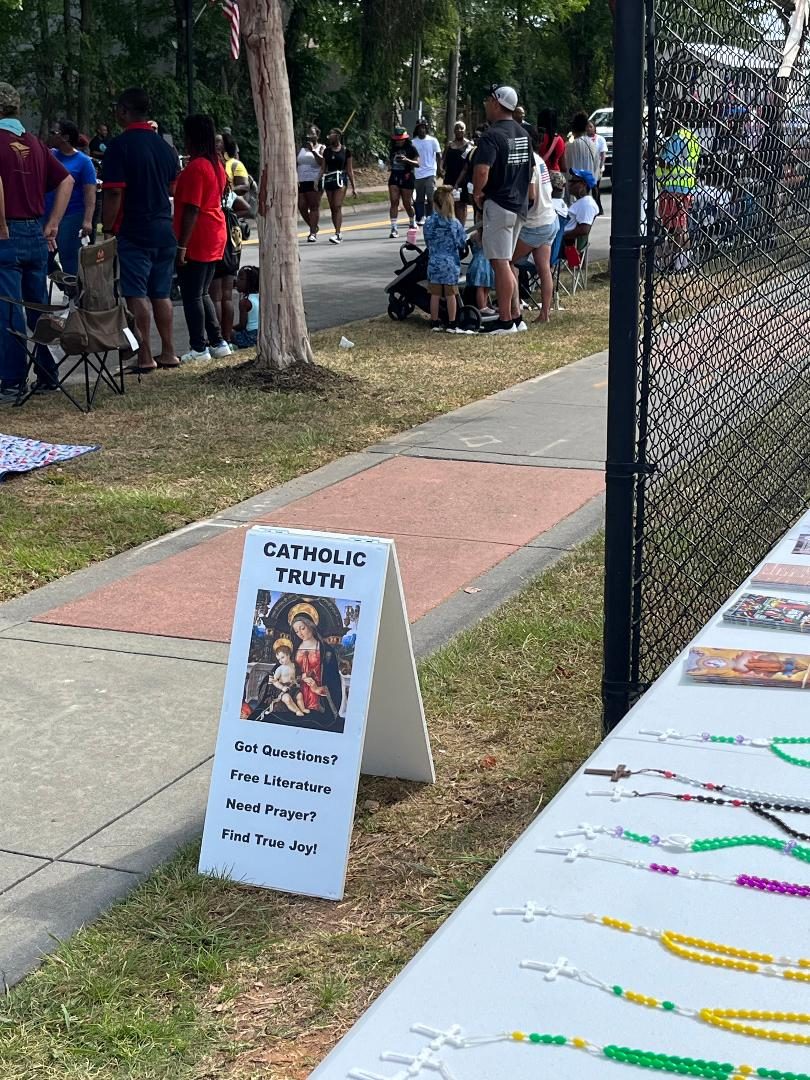
Our city hosts an annual 4th of July parade, followed by a festival. July 4th is a fitting occasion to proclaim the true freedom Christ brings from sin and the fear of death! This was the first year the festival was held in the new Town Green. Our team set up a table across the street from the Town Green, at the end of the parade route, to greet people as they made their way to the festival. Two parishioners joined for the first time - Kevin and John, a newly confirmed Protestant convert - along with our parish priest, Fr. Leandro.
Prior to attending the street evangelization event, I was a little apprehensive. But Jeremy provided a short training video with a method to speak with people. It was lovely. I mentioned to Jeremy during the event, that mingling with other people is such a needed thing for all of us to do. In a short time, I saw people I know that I wouldn’t have seen or been able to speak to if I had not attended. For me, the most beautiful thing was to ask families who were walking by if anyone would like a rosary to help them pray. Some walked by politely declining. But others stopped and said yes. When I gave a child a rosary and told them they could wrap it in their hand or hold it in their pocket to remind to pray. And said, they could pray to ask God to keep them safe, to help them be good and to stay away from bad thing and bad people, and God would do it, I heard more than one parent exclaim from the back of their throats, yes! Serving our parish in this way was a blessing for me. - John Ash
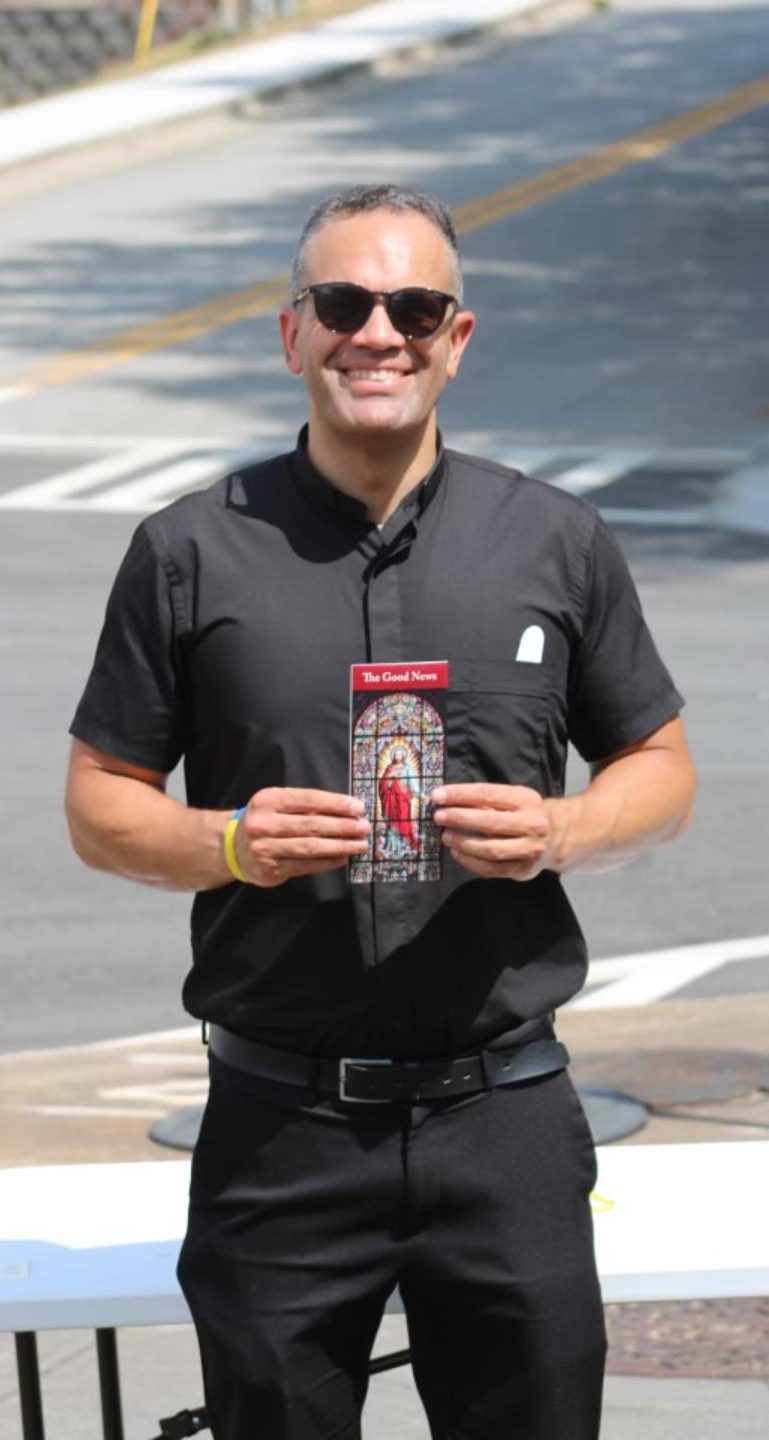
Though we did not initiate conversations until after the parade, we had the table setup and a couple of people came up on their own initiative. One younger man came with his son and teenage brother to tell us that he had recently been baptized in a local non-denominational church. I was sincerely glad to hear this and explained to him why the Catholic understanding of the graces conferred by baptism makes me all the more glad to hear of people's baptisms.
Soon after the parade, a different evangelism group set up a speaker across the street from us and started preaching and handing out tracts. While I was engaged in an in-depth conversation with a young man named Ernie, who was asking me all kinds of challenging theological questions (I discovered later that he was part of the group, and was pretending to be interested), someone from this group approached our table and got into a hostile conversation with my team members, including our parish priest. I heard him scoff, "You are teaching the traditions of men," as he walked away.

I walked across the street to introduce myself and find out where they were from. They were from a local Baptist church that I was familiar with. My intention was to build a bridge with them and encourage them in what they were doing, so I praised the church's sports ministry and pastor. They were friendly, but when I explained my background as a Protestant evangelist and how my Gospel presentation as a Catholic is essentially the same, they started hounding me with objections and questions (I was not looking for a debate with them!). Knowing that this was going nowhere, I asked the young scoffer, "Are you open to the possibility that you misunderstand what Catholics believe and do?" He said, "No, because I have the Holy Spirit and I can clearly see that your practices are offensive to Jesus." I rebuked him for the arrogance of this position, and walked back to our table.
Later, as the crowd had thinned, one of them walked over to engage us. He was friendly enough. I gave him our Gospel tract and asked him to look over it and tell me if he found anything in it that made it a "different Gospel" as they claimed the Catholic Church teaches. He could not, of course, but then went on to accuse us of being idolaters and urged us to "trust in Christ alone for our salvation." I challenged him that he was imposing his own misinformed perspective on to Catholics to judge what we do and that he should seek to understand from our own perspective. Lacking any sort of self-awareness that he even has a perspective, he said "I'm just telling you WHAT IS."
When I shared that the hostility does not go both ways, but that I would be sincerely glad if an unbeliever believed in Christ because of them and was baptized in their church, he argued that I shouldn't be because the Council of Trent anathematized those who teach "justification by faith alone." I said he misunderstood what that meant. In other words, he wanted to insist that I should believe he was condemned and that I was going against the teachings of my Church!
From their perspective, our Gospel is 'different' because we don't believe in JFA. I challenged him to show me in the Bible a verse that defines Gospel as JFA. He read verses about grace, faith, and salvation, but I pointed out that none of these used these words (the only time "faith alone" is used says we are NOT justified by faith alone!), and he was reading JFA into it: "I'm not trying to convince you to believe what we do about justification, but you can't make your view of it the essence of the Gospel."
As we packed up and left, he asked me if it was worth the risk of being wrong (meaning that we actually were idolaters and God would judge me for that). I said "I'll rather trust a 2,000 year old Church's interpretation of the Bible than my own interpretation and that of your less than 300 year old tradition."
This encounter prompted me to reflect on our relationship with anti-Catholic Evangelicals, especially in the context of the work of evangelization.
1) Our evangelistic methods need to be culturally relevant.
Kevin, a cradle Catholic, was baffled by their street preaching and asked me what they thought they were accomplishing with it. They see examples of Jesus and the Apostles preaching in public spaces to crowds, and imagine themselves being faithful to this model. Herein lies a problem with Sola Scriptura Christianity - it is constricting where it doesn't need to be. Methods need to take into consideration the context, and we do not live in a culture where a street preacher is going to be respected and attract an attentive crowd. No one was stopping to listen to them. A friendlier, more conversational approach like ours is more appropriate to our cultural moment. Thus, St. Paul writes that he seeks "to become all things to all men that I might save some." (1 Cor. 9:22)
2) When we encounter Protestant evangelists, we should recognize ourselves in them and rejoice that the Gospel is being preached.
St. Paul writes about rival evangelists who were causing trouble for him:
Of course, some preach Christ from envy and rivalry, others from good will. The latter act out of love, aware that I am here for the defense of the gospel; the former proclaim Christ out of selfish ambition, not from pure motives, thinking that they will cause me trouble in my imprisonment. What difference does it make, as long as in every way, whether in pretense or in truth, Christ is being proclaimed? And in that I rejoice. - Philippians 1:15-18
Since we found their methods off-putting - and ineffective - we worried that others would associate us with them. They even tried to interfere with us to an extent, at one point criticizing "using beads to pray" on their loudspeaker. But it is not our place to judge their motives. What they were proclaiming was generally true, and the same Holy Spirit can and does use these words to bring saving grace to souls.
3) Some Protestants cannot accept that Catholics preach essentially the same Gospel.
This group jettisoned my attempt to build common ground and acknowledge a common mission. This is a result of a deep, settled bias against Catholicism that is tied to their own sense of religious legitimacy. For only the charge that the Catholic Church preaches a "false Gospel" can justify the Protestant split from the Church and their ongoing revolt against the Church's authority. For them to accept that we are preaching the true Gospel raises all sorts of uncomfortable questions about why it is then acceptable for the Church of Christ to be fractured.
4) When evangelizing, our debating with Protestant brothers, we need to be careful not to impose our perspective of them on to them, for we would not have them do the same to us.
Perhaps the most disturbing part of this encounter was their insistence in judging Catholics according to their own misunderstanding of what we believe. They imposed on us their own understanding of words Gospel, idolatry, anathema, etc. - and would not accept that we meant something different by these words. We feel disrespected, and know it is uncharitable, when others want to define what we believe on their own terms, rather than seeking to understand us from our own perspective first.
But we are all prone to the same tendency, whether talking with a Protestant Christian or an unbeliever. This is why good listening is an important practice in evangelism. We need to make people feel that we understand them on their own terms, even when we disagree and wish to change their beliefs.
5) It's usually best to avoid getting entangled with Protestant evangelists we are doing an outreach, especially if they are hostile.
Our main mission is not to reach staunchly anti-Catholic Protestants. This doesn't mean we should never talk with them, but we are there mainly to bring the unchurched to Christ and into His one holy, catholic, and apostolic church. Furthermore, I would rather their attention be turned to the non-Christians they are their to reach (even though they think they need to save our souls too!). In the future, if they try to distract us with theological debates, I will say that this is not why I am here and invite them to call me if they really want to have a conversation.